Showing posts with label Bingham. Show all posts

Wednesday, July 18, 2012

Did you know?

Did you know that the Bingham and McKinnon families were always meant to be together?

Not only with Gene and EllaMae, but generations before.

You see our Gene McKinnon's great grandpa on his dad's side, Archibald McKinnon Sr, and Ella Mae Bingham's great-great grandma on her mom's side, Jane McKinnon McPhail, were brother and sister.

Friday, June 1, 2012

Graduation


Since its graduation time, here is a picture of Grandma on her graduation day in 1943. Isn't she cute!


Ella Mae Bingham High School graduation


Friday, December 2, 2011

Stephen and Sally

               Stephen Hadlock      and         Sally Alton


                          1790-1847                                                          1796 - 1880


How we relate:
They are the parents of Chastina Hadlock Allen
Who is the mother of Emeline Clarissa Allen Bingham
Who is the mother of Leonard Bingham
Who is the mother of Ella Mae Bingham McKinnon
who is the mother of Don McKinnon

      The first of the Hadlock family  left England to come live in the United States around 1638 - brothers Nathaniel and James (we come through James).

     Stephen Hadlock was born on February 12, 1790 in New Hampshire. He was the tenth child for his parents, Jonathon Hadlock and Elizabeth (Betty) Pettee (or Pattee). His siblings names were: Abigail, Samuel, Hezekia, Jonathon, Joseph, Betsy, Peter, Mariam, Rhosa and Amos. His oldest sister, Abigail, died either at birth or shortly after. Just after the family relocated to Jay, Vermont,  Stephen's father, Jonathon, died in 1801, when Stephen was just 11 years old.

     In 1814, when Stephen was about twenty-four years old, he enlisted in the army to fight in the War of 1812. Soon after his enlistment the war ended in 1815 and Stephen found himself in New Hampshire. It is in New Hampshire that met a girl named Sally Alton and they were married on December 5, 1816.
   
      Sally was born on 23 Nov 1796, to Abel Alton and Irene Sanger in Windham, Connecticut. Her siblings names were: Polly, Nancy, Orin, Abel and Irene. Sally gwas raised as a child in Conneticut but at some point must have moved with her family to the Vermont/New Hampshire area.

    After Stephen and Sally were married, they settled in Jay, Vermont for a time - which was close to the birthplace of the Prophet Joseph Smith.  In 1817, Stephen and Sally had their first child, a daughter they named Lucretia. After Lucretia was born, they had a new child about every two years until the last child who was born in 1843. Their childrens names were: Lucretia - 1817, Persine - 1819, Irene - 1822, Nathan - 1824, Orrin - 1826, Chastina - 1828, Rosina - 1831,  Cecilia - 1836,  Esther - 1841 and Henrietta in 1843.  In total they had eight daughters and two sons.

    An interesting note is that Irene, the third child, was born with mental disabilities. It is not know what kind she had, but on many census', Irene is listed as "Insane" or "Idiot." In the old OLD old days, those terms were used for people "with profound mental retardation having a mental age below three years." Sweet Irene lived with Sally until the end of Sally's life, then went on and lived with her siblings. 


      Soon after the establishment of the Mormon church, Sally and Stephen and some of their children were baptized into the faith of The Church of Jesus Christ of Latter Day Saints in the June of 1833.

      The Hadlock family traveled along with the rest of the members as they looked for a place to settle. They lived in Nauvoo for the years the saints lived there, then left with in the first group to leave Nauvoo in 1846 when they were driven out of the state. They left with the same company as Brigham Young, but only made it as far as Winter Quarter's when Stephen got ill. They spent one winter at Winter Quarters, hoping to see if Stephen would get better. 


File:Winter Quarters by C.C.A. Christensen.png
Depiction of what Winter Quarters looked like

      They built a small house to live in as they prepared to go westward. Before Stephen got sick, he had built  two wagons and had two yoke of oxen for each wagon along with all the necessary equipment ready to go when it was time. Sadly his health continued to deteriorate and he never got better and died on September 9, 1847 at age 57.  A source says he died of the plague but after looking into the illnesses and diseases that had taken over Winter Quarters, I believe he may have died of something else. The main causes of death at Winter Quarters among the Pioneers were Malaria and Pnemonia, followed closely by Dysentary and Tuberculosis. He had suffered much due to the conditions and tribulations that came to them on their journey west, and he could not beat this illness.

      After her husband's death, the rest of the family stayed at Winter Quarters for another year, and in the 1849 Sally continued on west with her family of two sons and eight daughters. Nathan and Orin - the sons of the family each drove a wagon.    At one point in the trek westward, Orin became very ill and couldn't drive. Sally and her daughter Chastina took turns at driving in his place.

      The family arrived in Utah towards the end of 1849 and settled in the Ogden territory. This is where most of her children married and lived with their children. Sally was the head of her own household until her death. She died on February 28, 1880 and is buried in the Ogden City Cemetary next to many of her children.


Sources:


Wednesday, November 9, 2011

Albern's wife, Marcia

I haven't been able to find any pictures of Albern, but I have found this one of his wife - Marcia Allen.


1804 - 1866


Her parents were Gideon Allen and Rachel Hand.

Friday, November 4, 2011

Albern

Albern Allen


1802-1862


Husband to Marcia Allen


How we relate:
who was the father of Emeline Clarissa Allen Bingham
Who was the mother of Leonard Bingham
who was the father of Ella Mae Bingham McKinnon
who is the mother of Don McKinnon

             Albern Allen was  born in Cornwall, Connecticut on 22 May, 1802 to Daniel Allen and Clarissa Dewey. By the time he was four years old, Albern and his family had moved to Hartwick,  New York, where his younger brother Daniel was born.  His mother Clarissa died around that same time in 1806.
            Albern's father, Daniel was one of the first medical doctors in New York. They lived there until about 1811 when the family moved to Chataqua County. His father also fought in the War of 1812 while living there.  
             Sometime in 1826, Albern met a girl named Marcia Allen.  Though her last name was Allen, records going back 8 generations show that their individual Allen lines go in different directions.  The same year of 1826, Marcia and Albern got married.  They lived in Ostego and Delaware counties of New York for the first years of married life. Here they had their first three children: Rufus in 1827,  Alanson in 1829 and Clarissa in 1831.
             In 1833, the family had moved to Mansfield, New York. Mansfield was a new  community established in 1830. Here they lived the life of the frontie. It is where Albern and Marcia's fourth child, Marshall was born.  It is also the community where they would meet missionaries for The Church of Jesus Christ of Latter Day Saints and change the direction of their lives and the lives of their posterity. In 1835 the Allen family was baptized and moved to Missouri to be with people with the same faith. 


         They settled in Caldwell County, Missouri, in 1836. In July 1838 Albern was called to be a member of the Quorum of the Seventy for the church. Just a few months later, the terrible persecutions of the Missouri saints reached their peak, beginning with the slaughter at Haun’s Mill.

A little background info: (from Albern's life story submitted to the Sons of Utah Pioneers foundation)
    The saints eventually left and settled in Nauvoo, Ilinois. After settling in Nauvoo for a time,  Albern left to serve a short mission to the southern states. When he returned to Nauvoo, he was able to go into the temple and be sealed to his wife Marcia.  He also served as a lieutenant in the Nauvoo Legion. The Nauvoo Legion was an organization of a Militia unit consisting of members of the church.  The state of Illinois had granted Nauvoo to be a very liberal city that gave the Nauvoo Legion extraordinary independence which Joseph Smith led.
History tells that Haun’s Mill could have been only the appetizer to the slaughter that almost happened in Farr West as told in the following account: “The mob grew bolder and bolder, and committed depredations upon the settlements in Caldwell and Davies Counties, so that our people had to flee into Far West from all quarters to save themselves. Many could not get into houses, and had to take shelter in wagons, tents, and under bedclothes, and while in this situation we had a severe snow storm, which rendered their sufferings intense.

On the morning of November 1st, Hinkle [a leader of the militia that was to exterminate the saints] took another step to carry out his nefarious designs. The bugle sounded for the brethren to assemble, armed and equipped. Every man went out well armed and was paraded and delivered over to the enemy. The brethren were surrounded and required to surrender their arms, and were then guarded all day while the rapacious soldiery went from house to house, plundering, pillaging, and destroying, and even driving many helpless women and children from their homes, and committing deeds even worse than these in some instances.

A court-martial was held by the officers and priests, and without being heard in their own defense, the brethren were sentenced to be shot on Friday morning on the public square in Far West, in the presence of their wives and families. At this unprecedented action General Doniphan objected, saying he would have nothing to do with such cold-blooded actions, and he would draw off his brigade from the army. This probably saved the lives of the prisoners, as the sentence was changed and the prisoners were taken to Independence, Jackson County.”

Though they were not slaughtered, they were forced to leave their homes and belongings and move on in the middle of winter. So, in the winter of 1838-39 he and his family fled from religious persecution to Adams County, Illinois. In doing so, they were forced to sign over their Missouri property of 80 acres to the mob. Several sources show that Albern filed a petition on 7 January, 1840 before justice William Laughlin of Adams County, IL, seeking $1320 in redress for his suffering in Missouri. The petition included $150 to leave the state, $600 for land, $100 in stock, $50 in beef and pork, $20 for farming utensils, $400 moving because of extermination order.


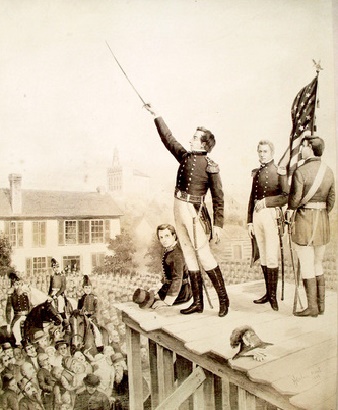
File:GeneralJosephSmithAddress-JohnHafen.jpg
General Joseph Smith's Last Address, by John Hafen 1888

File:NauvooLegion.jpg
Depiction of Joseph Smith at head of the Nauvoo Legion. Notice Nauvoo Temple in the background


         Albern was called to be the senior president of the Thirty-third Quorum of the Seventy in 1846. Life in Nauvoo was happy for a while. Albern worked as a skilled ox bow maker. He was know for his long days of  hard work. The family prospered along with the growing and thriving city of Nauvoo. 

Hickory Bows
Ox Bows

10" Ox Yoke complete w/bows
Ox Bows in a Ox Yoke


    The saints lived in Nauvoo for about six years when the persecution and the mobs drove them from that city. The left Nauvoo in April of 1846 and went to Kanesville - later known as  Council Bluffs,  Missouri where they made camp. After the camp was made, Mormon leaders were immediately concerned over two major problems: sending an advance company to the Rocky Mountains, and locating a place for the rest of the people in camp to build winter quarters until they, too, could go west in the spring. This place became known as Winter Quarters.


      The saints began to run out of supplies, resources, and had little hope of any source of income by this time. Mexico and the United States were having issues and the US ultimately declared war on Mexico. This war gave the saints opportunities to join the war and earn money to provide for their families.


       After arriving in Council Bluffs, Albern and his oldest son, Rufus Chester, enlisted in the Mormon Battalion in Company “A”.   Marcia, his wife, was ill and had been staying in the wagon most of the time which left another son Alanson in charge of the family while Albern and oldest son Rufus were gone.  Albern and Rufus left Council Bluffs on July 20, 1846. Since a military uniform was not mandatory, many of the soldiers sent their clothing allowances to their families in the Mormon refugee encampments in Iowa.

      Albern marched with the Battalion from Tucson to Ciudad de los Angeles where he was discharged on 16 July,1847. Two of the battalion leaders were described as the "heaviest burdens" of the trek. The soldiers suffered from excessive heat, lack of sufficient food, improper medical treatment, and forced long-distance marches under their leadership. The Battalion split towards the end of 1846, the sick stayed behind, but Albern stayed in the division that continued on. They marched to California when the battalion was disbanded.


       Along with many of the soldiers, Albern and his son Rufus migrated to the Salt Lake City Valley in 1847. His family was somewhere enroute to Salt Lake from Council Bluffs. Albern and Rufus stayed in Salt Lake helping to settle the valley and built buildings when in 1848, they met their family about 100 miles east of Fort Laramie in Wyoming. When they met up with them, they learned that two of Albern's young children , Rachel -10 and Sarah -3, had died in Winter Quarters. 
       A year later in 1849, the family moved to Ogden in Utah.  By 1850 Albern was considered Ogden's most notable farmer, even though his real wealth was only $50 (Utah Federal Census, 1850). He produced 450 bushels of wheat, 40 bushels of Indian corn, 50 bushels of corn, 100 bushels of potatoes, 25 bushels of buckwheat, 100 pounds of butter, and 250 pounds of cheese on a twenty-acre farm valued at fifty dollars.

        Albern served as a president of the Thirty-third Quorum of the Seventy. He represented Weber County in the Utah Legislature for two terms. He was also a member of the Weber Stake High Council.  


       During these years, he entered into plural marriage and married Mary Ann Hoops Yearsley, Mary Jane Morris, and Jane Elizabeth Hill.

        The following is quoted from an article from the Nauvoo Visitor Center:

 
“On 19 April,1857 Albern was given his patriarchal blessing by James Lake (patriarchal Blessing Index, 701: 19). Later that spring he accepted a mission call to Canada. He crossed the plains pushing his possessions in a handcart. In Genoa, Nance County, Nebraska, he was asked by Apostles John Taylor and Erastus Snow to remain in Genoa and preside over a small branch of the Church (Carter, Treasures, 2:430). He presided in Genoa until 1858 when he returned to Ogden having never served his mission in Canada. Albern was selected as a counselor to Bishop Edward Bunker of the Ogden Third Ward. He became known as a liberal, broad-minded man who was willing to render both financial and spiritual aid. "


Albern Allen died on 3 June, 1862, in Ogden, Weber, Utah. Marcia later moved to Iron County where she died and is buried.


Sources:
  1. Sons of Utah Pioneers Collection, story submitted by LaRon Taylor 
  2. Ancestry.com 
  3. Journal of Thomas Bullock…,BYU Studies, Bol 31, Number 1- Winter 1991
  4. L.D.S. Bigographical Encyclopaedia, Vol.3, by Andrew Jenson
  5. Church Chronology by Andrew Jenson
  6. The Mormon Battalion, 1846 & 7, by Kate B. Carter

Friday, September 23, 2011

Leonard Bingham Autobiography

Below is life sketch written by Leonard Bingahm about his own life. 


Leonard Bingham
Autobiography
1893-1968


How we relate:
He is the father of Ella Mae Bingham McKinnon
Who is the mother of Don McKinnon


I was born on 6 October 1893 at Huntsville, Weber County, Utah. My first picture was taken when I was about six months old. It was a family picture with dad holding me and mother holding my twin brother, Lorin. We were both in dresses with a blond curl on top of our head.
I was the sixteenth child, my brother, Lorin, being the fifteenth. One of my early recollections was  when I was four years old. 1 was sick and lying on the bed when my sister, Olive, came in. She said if I would let her remove my cold sore scab from my face she would give me something. I agreed and she gave me a package to open. It was my first store overalls. Before this all my pants had been made by my mother. I felt grown up with new store overalls.   


Erastus Perry Bingham Family - 1894
Back (L to R): Louisa Marinda, Olive Rebecca, Joseph Franklin,
Albern Allen, Francis, Emeline Chastina.
4th row: Perry Alanson, Father Erastus Perry Bingham,
Mother Emeline Clarissa Allen Bingham, Mary Lucinda.
3rd row: Clarence, Lorin (twin), Wilford Levi, Leonard (twin).
2nd row: Thomas Lorenzo, Erastus Edward, Ezra.
Front: William Henry

Erastus Perry Bingham Family - 1894

I started school when I was five years old for two months in the spring. The teacher could not tell Lorin and me apart. So we started fooling the teachers from time to time. If one of us had to stay during the noon hour, we took turns sitting in the seat while the other had lunch. We never missed our lunch and no one was the wiser.
When we reached the third grade, they consolidated the schools String Town and Huntsville. This is when we learned to fight. It was fight or get beaten up. We would not have minded if they had all been our size, but the larger ones seemed to think it was a free for all. We might not have fared so well had it not been for my cousin, Josie Allen. She jumped in to help us out and soon they left us alone.


Family of  Erastus Perry Bingham & Emeline Clarissa Allen Bingham

Back row: Joseph Franklin, Erastus Edward, William Henry, Thomas Lorenzo,
Albern Allen, Ezra, Leonard, Lorin & Clarence
Middle Row: Cedina, Louisa Marinda, Francis, Emeline Chastina, Erastus Perry
Bingham, Emeline Clarissa Allen Bingham, Perry Alanson, Olive Rebecca & MaryLucinda
Front row: Arnold Hyrum & David Moroni
Not pictured: Wilford Levi (who died from typhoid fever in 1900)


It was some time before this that my older brothers started losing their lunches at school. Someone was taking them just before lunch time. Mother always had doughnuts or pie in our lunches. I think this was the reason. When mother learned about this, she decided to do something about it. She ground some rhubarb root and added it to the next batch of doughnuts. Now all they had to do was wait. Soon the teacher decided three girls were leaving the room all too often and asked for the reason. Dave Newey, a cousin, offered this information. Mrs. Bingham's boys have been losing their lunches, so she added some "California quick silver" to the doughnuts. Now those girls have the "rocky mountain quick step". This was the end of the lunch stealing.

We always had a nice Christmas. We did not get as many presents as they do today, but we were satisfied with knitted mittens, socks and some little thing we might get. The family and friends were always dropping in.
  
Twins Leonard and Lorin


A tragedy came into my life when my brother, Wilford, died. Wilford was just older than Lorin and I. He took sick when we were at Grandma Allen's. Lorin and I pulled him home in our little wagon. We did not think he was that sick and we missed him terribly.

I believe we had more fun as boys than most boys today. We herded cows up South Fork Canyon in the spring. Then after we cut the first crop of alfalfa and timothy hay, we herded the cows in the fields. We knew where the best choke cherries grew, the best apples and watermelons, too. We were like the bears, we lived off the fat of the land. The fishing was good, the Sage Hens plentiful and there were plenty of deer in the mountains. Kid dances were a sport in the winter, too. When money was scarce we twins had it over the others and took turns dancing as most people could not tell us apart. Mother, though, never seemed to get us mixed up. We liked to go swimming and fishing. We had several good swimming places. One in South
Fork of Ogden River.

We had a baseball team up String Town. We played with the Huntsvllle team, Eden and Liberty. The sleighing was great in winter, as was the coasting and skiing down the mountain slope. There was always plenty of ice to skate. All you needed was the ambition to participate. I liked to skate and got so I could cut figures.

We finished our grade school in Huntsville. Lorin and I still fooling people as to who was who. Many are the lickings I took for him and he will say the same. But we can't deny we had fun. When we got caught for some mischief, we would say it was the other one and there were times we avoided punishment. But there were the times we took it for the other one or both to make sure the right one was punished. So it had its advantages and disadvantages. I attended high school at the Old Weber Academy, now Weber College.

In 1916 I went to Idaho where I took up a homestead. I was there two years when I was called into the Army in 1918. I did not get overseas. I was stationed at Fort Lewis, Washington, Company I, First U. S. Infantry. I came home after the war ended in 1919. I farmed in Idaho that year.

In February 1920,  I landed in Beckwith, Wyoming, ten miles south of Cokeville. My brother, Frank, had bought a ranch there. I was a junior partner in the Lincoln Ranch. It consisted of 3400 acres, 2200 was in hay and grain. I was there only six weeks when we heard our brother, Will, had died of influenza. Will's wife had died only two weeks before. This left five children without dad or mother. I took the first train back to Blackfoot to attend the funeral. After the funeral, I took Carvel back with me to Frank and Annie. They were going to keep him. I was wishing I was married so I could have taken one of those poor frightened kids.

From the time I was about five years old, I spent a lot of time at my brother, Frank's. He was a second father. I took his cows to the pasture, helped in the hay field, or what other odd jobs he might find for me to do. His boys were like brothers to me. Annie, Frank's wife, was good to me, too. Walter and Golden, Frank's two oldest boys, followed me around and we had lots of good times. Golden played the piano and we all sang. When we had nothing better to do, we sang to the cows.

On the Lincoln Ranch it fell to me to do the range riding. Golden usually went with me. It was Golden who went with me this time. It was fall, and we were riding for stray cattle. That night where we stayed the women had so many flowers in the room that it made me sick. We didn't sleep much anyway because when we were assigned beds there was a couch for one, and we were told the other could sleep with a man known as "Four thumbs
.  The woman said he had just that — four thumbs. I hurried and got the couch. Golden took one look at Four Thumbs and said, "Move over, I'm sleeping with you". So we both slept on the couch. We rode to Davinson's Ranch the next day. They gave us a pup and we took it home to Carvel. Then Frank decided to move back to Utah. He bought a place in Morgan. I did not have capital to go on myself so I went to Randolph, Utah, and got a job working on the Diamond J. Ranch.
I worked on the Diamond J. for a year. It was while working there I started going with the girl I married. I had met her two years before at a dance. We had a lot of fun that summer. There is a summer resort at Bear Lake with swimming, boating and dancing. Dancing was our main sport. Some horseback riding was also there. Mable and I were married on the 21st of February 1923. Apostle Joseph Fielding Smith performed the ceremony in the Salt Lake Temple. I continued working at the Diamond J. that winter. The following May I rented a ranch from my mother-in-law. We lived there for the next few years. Then she decided to sell and we moved to town.

On 3 December 1923 our first child was born, a boy. The doctor held him up, spanked him and said, "Here is your little sheepherder".  ElMont was not fragile by any means, but I was afraid to handle him so I carried him around on a pillow. When he was about six weeks old, I decided to clean a chimney that had been giving us trouble. When I had finished I went to see if I had done any good. There was my tiny son lying on his pillow smiling up at me through his black face. I laughed for it was quite a sight.

Nineteen months later we were blessed with a little girl. She was born on 18 July 1925. We named her Ella Mae. You could say she was black when she was born for the cord was wrapped around her neck shutting off the air. Dr. Reay worked fast. Finally he said, "Here she is that was a close one, but we saved her. "As it turned out, she was our only girl. She had another close call when she was nine years with appendicitis. But we made that, too.

We had one more little bundle to complete our family. Twenty-three months later, we had another boy. Fred Brough Bingham was born 25 June 1927. All three have curly hair. By the time Fred came along, I felt more confident in handling him. I dared to pick him up and toss him around. He was a very good natured baby. When he was just big enough to walk, he followed his Uncle Eldon to a neighbor's where they were painting a car. He came back all painted up. He started young, for cars have been his main interest. He now has a nice garage in Ogden, Utah, "Bingham Garage". This is how he makes his living.

"In 1931 depression hit the country. Those who did not own a place large enough where they could make a living were hard hit. I was no exception. The next four or five years there were few jobs to be found. You made your own job or went hungry. I went to the canyon, hauled out logs wading in snow to my hips in winter. Ranchers who had always hired men now hired their son or relatives. It was in 1937 the contractors started to come in and I was able to get a few jobs again. The trouble was they were short lived and before you knew it you were out of a job again.

In 1942 I went to Ogden to see if I could get a job. War plants were opening up and many were being employed. I decided to try my luck. Two fellows went with me and we all found work. I got a job at Hill Field. Now called Hill Air Force Base. I worked as a carpenter and woodworker. I started in April and my family stayed in Randolph to finish school. I was unable to go home for ElMont's graduation in May. ElMont was very disappointed and so was I. I moved my family to Ogden the end of May. We have been had we made the move. Ogden had more opportunities to offer my family now they were getting older. I
worked at Hill Field for twenty-two years before retiring.

We lived in Randolph twenty-two years before coming to Ogden, so I left a few land marks there; I built our home there and have helped to build many of the buildings there. Some of which are: Scout House, County Fair Building, Rich City, Court House, Sinclair Station, Recreation Hall, remodeling the church house, homes and garages. I served on the Town Board for four years. I kept busy in the church, serving two Stake Missions. My last mission was in 1940 and 1941. Mable and I were both called along with ten others. We visited homes, held cottage meetings, also organized a Sunday School at Sage, Wyoming, twenty miles from Randolph. Four missionaries took turns supervising the Sunday School there. This was a happy time and we made lots of friends. We hope we did some good. The last year I was Branch President and Mable was Secretary.
I am now a High Priest in the Church of Jesus Christ of Latter-Day Saints. Some church assignments I have filled are: Teacher in Sunday School, also in Sunday School Superintendence, teacher in M.I.A., Scout leader, Work Director of the Church Welfare Program and two stake missions. In my high priest quorum, I was secretary for two years, assistant Group Leader for three years and Group Leader for three years. I was ward teacher supervisor for five years and have always served as a ward teacher.
One of my worthwhile accomplishments was the building of our home in Ogden. I built on in Randolph, but it was not all we hoped for, so I promised my wife I would build her a larger and nicer one some day. Our Ogden home was the fulfillment of that promise.

In May 1962, I retired from my job at Hill Field. My wife and I are spending the winter in Mesa, Arizona. Our daughter lives there. Our boys in Ogden, so we intend to spend the winters here where it is warmer and the summers in Ogden where we can spend time with our boys and their families. Next week, 21 February 1963, we will celebrate our 40th Wedding Anniversary.
       
Mabel Brough Bingham

Leonard Bingham

Added by me: 
Leonard's wife, Mabel died about 3 years later in December of 1965 of Colon Cancer. He married Edna Raines civilly in ____.  Leonard was in a car accident which did not kill him though he never fully recoverd and he died on October 8, 1968 and is buried next to his forever sweetheart Mabel in Ogden, Utah.


Sources:
  • 1963 Autobiography of Leonard Bingham found in the book: The Descendants of Erastus Bingham and Lucinda Gates
  • Photos of Leonard reterieved from my father's family history items
  • Erastus Bingham family photos  given to me by Stephen McDonald - Great Grandson of Erastus

Tuesday, September 20, 2011

Working on the railroad

Below are pictures of men working on the railroad in Utah.

On May 10, 1869, at Promontory Summit (56 miles from Ogden), the first  of five transcontinental railroad 's were completed. Alanson Allen and Erasust Perry Bingham were among the people that worked on it and were there the day the last spike was driven. These pictures are from Utah's historical archives. 


Working on railroad.


Day of railroad completeion. 

Friday, September 16, 2011

Archibald McPhail and Jane McKinnon

This is interesting in our family history in part that the Bingham and Mckinnon line crosses here...just a few generations before Ella Mae and Byron get married and it crosses again. Jane McKinnon is Archibald McKinnon's older sister. Archibald is who Byron comes out of and Jane is who Ella Mae comes out of.


How we relate:


Parents of Jane McPhail Peart
who is the mother of Mary Jane (Mae) Peart Brough
who is the mother of Mable Brough Bingham
who is the mother of Ella Mae Bingham McKinnon
who is the mother of Don McKinnon


Archibald McPhail was born on May 11, 1816 in Renfrew, Scotland. His parents’ names were Archibald McPhail and Margaret Milloy. 

            On April 26, 1839 Archibald McPhail and a woman named Elisabeth Love booked their names for three days proclamation of banns on purpose of marriage with their Parish. (The banns of marriage was a public announcement from the Christian church of the impending marriage. The purpose of banns was to enable anyone to raise any legal impediment to the marriage, prevent marriages that are invalid. People would “book” their names for a few days in advance of the marriage to give people a chance to bann it).

            In 1840, the first Branch of The Church of Jesus Christ of Latter Day Saints was organized in Paisley, Scotland by Orson Pratt on May 8. Archibald and Elisabeth were baptized two months later on July 19. On August 3rd of the same year of 1840, Archibald and

Elisabeth had their first son, John, in Argyll.  Later the next year, Archibald was ordained a Teacher.

            On September 5, 1842 they had a daughter and named her Henrietta.  Archibald worked as a boot and shoemaker and they lived in Renfrewshire for the next few years. The family also had opened their home as a boarding home for saints to live.

            In May of 1847, Archibald’s wife Elisabeth died at the age of 28, leaving him a single father of two young children. In July of that year, Elisabeth’s sister Jane Love went to live at the home of Archibald to care for her older sister’s children. Jane was baptized right after hearing the gospel that was taught to her in the McPhail home. Robert Baxter was a man that was boarding in their home and he eventually married Jane the next year. They continued to live with Archibald and care for the children.

            On March 4, 1848, Archibald, along with about 12 other saints, were excommunicated from the church for unknown reasons. (I am going to find out why. Some sources say that he was ordained an Elder in 1849 – but that doesn’t fit in the timeline, so I need to find that out as well)

On December 4 of 1849, Archibald McPhail and Jane McKinnon were married. Some records have stated that Jane McKinnon and Archibald’s first wife were first cousins.  

In 1851, the McPhail family was living in Greenock, Scotland. Archibald was 35, Jane 28, John 11 and Henrietta was 9. Henrietta and her stepmother Jane did not get along. Henrietta wrote later in her life that she and Jane were never on friendly terms.

Sadly in 1854, Archibald’s son died at age 14. This event may have spurred Archibald and Jane to be rebaptized as they were reconfirmed in 1855 on November 4th with about 12 other people at the Port of Glascow. Also in 1855, Robert and Jane Baxter leave with the Saints for America.

According to research done by McPhail and Peart descendents, Jane McKinnon had a sister named Catherine McKinnon McDonald. She had a daughter named Jane McDonald that was born in 1852. There are notes on an archival sheet of Archibald and Jane that say they adopted this little girl. Jane (the daughter) was found on the 1856 census, but not before. (I’m going to look more into this)

Henrietta was baptized in March of 1856 and in May of that year, they embarked on the ship The Thornton and left for America, James G. Willie was the leader for this journey. They arrived at the New York Port a month and a half later in June. While in New York, they boarded a steamer boat and sailed to Ohio, and then to Chicago where they took a train to Iowa City on June 26.

When they arrived in Iowa, the saints built the handcarts themselves and outfitted each cart with 90 days rations. The company was divided into 20 carts per group with a man placed over each group. Archibald McPhail was chosen to preside over one of these groups. In his group there were 100 saints. The company left for Salt Lake on August 27, 1856 – which was late in the year for saints to travel across the plains. This pioneer company became famous for all the trials they went through.

He was a captain in the Willie handcart company. He was a captain of 100. In this group there were two women who constantly lagged behind the others. Archibald’s daughter Henrietta tells of what happened:


"A terrible blizzard had been raging all day and when they reached camp Father found one of his group was missing.  There were two old ladies in his company who often lagged behind, coming into camp later.  When this one didn’t soon follow, Father felt it was his duty to go back after her.  It was indeed an undertaking for one so exhausted by the lack of food and nearly perishing with cold.  But he cheerfully accepted his responsibility and went in search of the woman.  He found her sitting by the wayside on the other side of a frozen stream they had crossed earlier.  He pleaded with her to come on, but she refused saying she was going to stay there and die.  There was nothing to do but cross the stream and get her.  He picked her up and as they recrossed the stream with his burden the ice broke and he was soaked with icy water to the waist.
By the time he reached camp his clothes were frozen to him and he was taking heavy chills.  The air was cold and wet and the men were so weak and hungry they could not go in search of dry wood to make a fire.  So without anything warm to eat or drink, he was placed in a cold bed with the covering of the handcart pitched over him for a tent.  There was a strong wind blowing which blew the tent over three times and they stopped trying to keep it up.  He was in a high fever and Henrietta sat by his bed, brushing the snow from his face as he lay dying.
After his death he was wrapped in a sheet and soon after day-break, after a short service, the snow was scooped away and he was laid on the ground and the snow covered back over him and they proceeded on their journey knowing full well that soon after they left the wolves would devour the body.  This account is well bourne out in other accounts of this company and the Martins to follow.  Because of the weakness of the men and the frozen condition of the ground it was impossible to dig graves for those who passed away.”

Below is an excerpt of the pioneer company journal written by James Willie:

       
  "Archibald McPhiel, from Greenock, Argyleshire, Scotland, died about 2 a.m. aged 40 years. Much snow on the ground this morning & still more falling. Go down Echo Kanyon, roads very bad at the crossing of streams; forded Weber River & camped on its banks. It snowed most of the day. The camping ground presented a most dismal appearance, as we rolled on to it there being much snow on the ground & it being late at night. Rasmus P. Hansen, from Lan Denmark, aged 16 years, died this evening"
Church historian  Paul Lyman said:  
 
“Cold” was noted on the 3rd and the 5th. After mentioning a snowstorm coming on the evening of the 5th, the record for the 6th reported that “it snowed most of the day,” which caused people to start dying again.
Archibald McPhail, like many unsung heroes, died simply doing his duty. He had been responsible for the 20 people assigned to his tent. On the evening of the 5th he noticed that one of two women who often lagged behind was missing. He went back along the trail and found her. She was on the opposite side of a creek. She refused to cross, saying she was going to die anyway and saw no need to cross only to die. He crossed over the creek on the frozen ice, picked her up, and started back across the ice. The additional weight of the woman caused the ice to break through and he was soaked up to his waist. He guided her into camp with his clothes frozen to his waist and legs. As the snowstorm raged, he went to bed on the snowy, cold ground wearing his frozen clothes. His wife used a handcart for a tent that night. Due to the wind, their handcart tent blew over three times. He died, with his wife holding him, never having gotten warm after rescuing his unnamed charge.1
Archibald McPhail left a wife and children ages 3, 4, and 15. With the death of Rasmus P. Hansen, Anna Hansen, age 40, his mother, was now alone. She had lost her husband on October 19th.
Echo Creek meandered back and forth across the canyon floor in 1856. The main trail crossed Echo Creek over a dozen times. In the heavy snow, the river crossings would have been even more difficult than usual. The journal confirmed that the road was particularly bad at the river crossings. The journal writer commented even more harshly on the campground. It was on the west side of the Weber River in the river bottom. It was late at night when they stopped and it had snowed all day. The snow-covered grass must have been particularly difficult to sleep on with their thin bedding. "


 Julie Rogers is a contemporary artist who paints pictures of stories of the pioneers and the selflesss acts that they did. She painted 3 of Archibald and his story. They are below.


Bishop McPhail by Julie Rogers


The Light Comprehendeth by Julie Rogers
  
The Light - Archibald and Jane McPhail by Julie Rogers


 Archibald is well known for his courageous and selfless act. The missionaries at the Pioneer Trek locations and other historical sites all know about him and talk about him with reverance.  Jane and her daughter continued on the trek. Henrietta was sent to live with and uncle. Jane later married Robert Baxter as a plural wife. He was the man who had boarded with them in Scotland. They later divorced and she married again. I will write about Jane in another post.


Sources: